The Admiralty Court Act 1854, effective 1 Aug 1854, provided for the collection of fees payable in relation to proceedings in the High Court of Admiralty by means of stamps to be provided and used for the purpose.
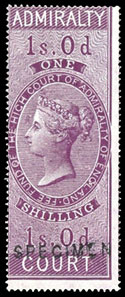
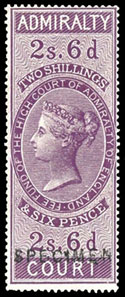
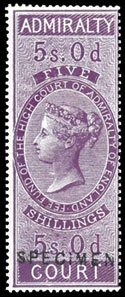
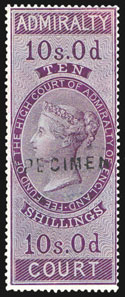
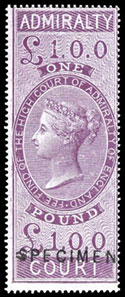
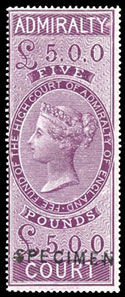
The plates were made by De La Rue before the familiar plate-number/current-number scheme came into effect and were simply numbered as plates 1 thru 6. The £5 stamp is the most scarce with only 148 sheets printed.
| Duty | No. | Registered | Destroyed | Sheets |
|---|---|---|---|---|
| 1/- | 1 | 27 Jan 1855 | 21 May 1878 | 1,050 |
| 2/6 | 2 | 14 Dec 1854 | “ | 1,550 |
| 5/- | 3 | 20 Dec 1854 | “ | 2,825 |
| 10/- | 4 | 14 Dec 1854 | “ | 1,000 |
| £1 | 5 | 14 Dec 1854 | “ | 575 |
| £5 | 6 | 9 Dec 1854 | “ | 148 |
The 1855 issue was on blued surfaced paper, perf 16, and exists with Specimen Type 2. The 1858 issue was on (A) blued surfaced paper, (B) white surfaced paper, (C) white unsurfaced paper, perf 14, and exists with Specimen Types 6 & 9. All are Flag with Anchor watermark.

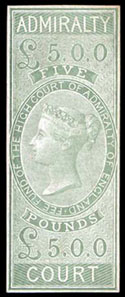
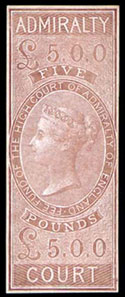
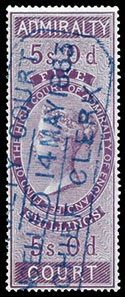
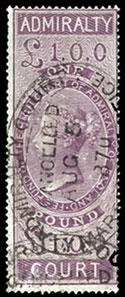
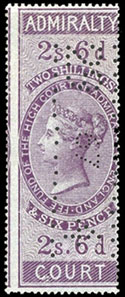
Watermark Flag with Anchor as seen from the front of the stamp (not used for any other stamps); cut-down die proofs in green and brown, possibly for the 1867 Paris Exhibition; and used with Admiralty Court Chief Clerk 14 May 1863, Admiralty Court Maritime Office oval 5 Aug 1870, and perforated fiscal date cancellation 29 Apr 1867.
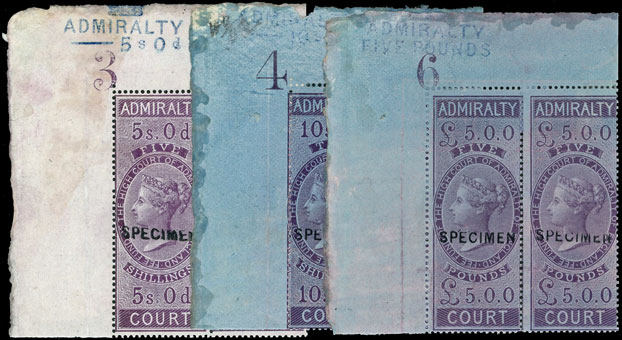
Corner pairs showing plate numbers 3, 4, and 6, the latter two on blued paper, all Specimen Type 6 with Admiralty handstamp (Stanley Gibbons).
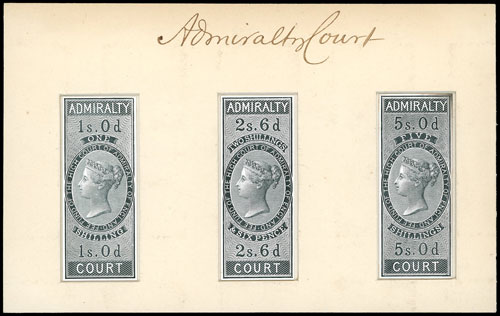
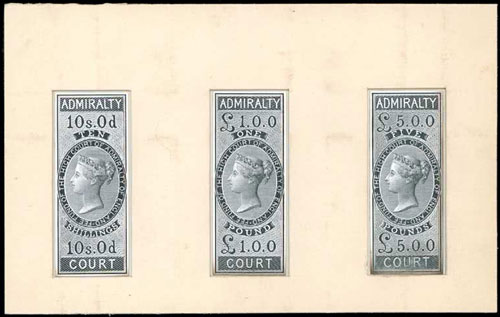
Six cut-down die proofs in black on glazed cards, mounted in two countersunk frames, presumably once part of the same presentation book (Grosvenor).
Admiralty Court stamps were replaced by Judicature Fee stamps in 1875.