In the US, “license” is used as both noun and verb but in the UK, “licence” is a noun (the document), while “license” is a verb (the act of granting). Hence, a Dog Licence was validated by applying a Dog License stamp!

Dogs required a licence in England from 1796 but the licence was a printed form which did not require a stamp. However, the Dogs Regulation (Ireland) Act 1865, effective 1 Jan 1866, did require stamps to be applied to a form at the rate of 2/- per dog. The Act begins “much Loss and Damage is suffered in Ireland by the Owners of Sheep and other Property by the Ravages of Dogs, and there is great Difficulty in identifying the Owners of such Dogs”. Additionally, the licence had to be registered at the Petty Sessions Court for a fee of sixpence.
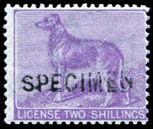
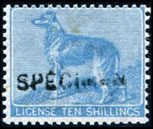
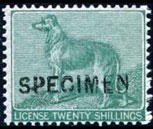
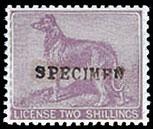
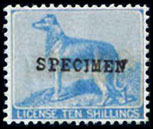
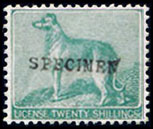
(Shamrock)
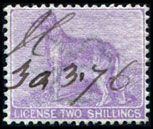
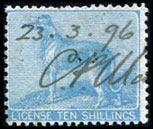
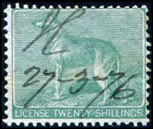
(Orb)
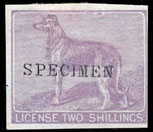
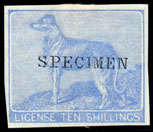
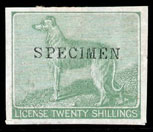
The design bore an image of an Irish Wolfhound by J W King based on a 1865 drawing by F W Kely. Although the original Irish Wolfhound is no longer with us, a modern breed was developed in the 1880s.
Three plates (numbered 1/267, 1/268, 1/269) were made by De La Rue and registered on 8 Dec 1865. The 2/- plate was 240 set and printed on Shamrock paper (later used for Telegraphs 1d, £1, and £5). The 10/- and 20/- plates were set as 12 panes of 20. A second 2/- plate (number 2/802) was registered on 1 Apr 1887. Two more 2/- plates (2/236, 3/237) were made by the Royal Mint at the end of 1912 although 2/236 was not issued until 1915.
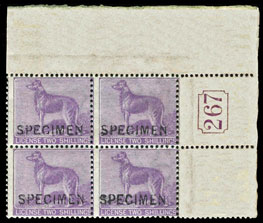
1/267
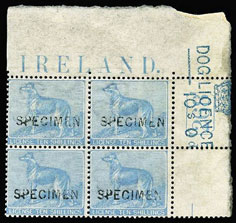
1/268
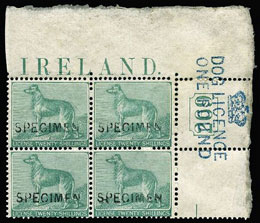
1/269
| Current No. | Duty | No. | Issued | Registered |
|---|---|---|---|---|
| 267 | 2/- | 1 | 6 Dec 1865 | 8 Dec 1865 |
| 268 | 10/- | 1 | 6 Dec 1865 | 8 Dec 1865 |
| 269 | 20/- | 1 | 6 Dec 1865 | 8 Dec 1865 |
| 802 | 2/- | 2 | 26 Jan 1887 | 1 Apr 1887 |
| 236 | 2/- | 2 | 23 Mar 1915 | — |
| 237 | 2/- | 3 | 6 Dec 1912 | — |
Note that current numbers were reset to 1 in 1911.
Watermarks
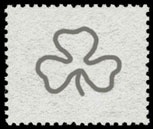
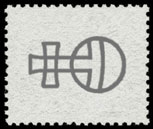
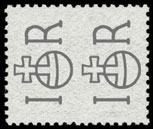
The 2/- was initially printed as a single pane of 240 (12 x 20) on Shamrock paper but, inline with other changes made around 1881, plate 1/267 was altered to have two panes of 120 (12 x 10) with an inter-pane gap to match the layout of the new Orb paper. The postal-fiscal penny plate was similarly altered from Small Anchor to Orb and a new registration sheet taken on 10 Feb 1881 endorsed “Proof after alteration of Plate”. Unfortunately, the altered Dog License plate was not registered but the penny plate provides an approximate date.
The 10/- and 20/- plates were similarly altered, the 10/- apparently requiring some repairs based on a die proof endorsed “29 Jan 81 Before Striking”; however, these values were not issued on Orb, the only know copies are reference copies overprinted SPECIMEN.
Four Shillings
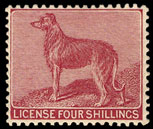
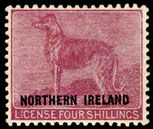
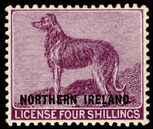
The Dogs Regulation (Ireland) Act 1919 increased the duty to 4/- for each dog, for the licensing year ending 31 Mar 1921. Three 4/- plates (numbered 1/757, 2/762, 3/771) were made by the Royal Mint at the end of 1920. Plate 1 was noted as “Bad Electro” and not used. Plates 2 & 3 were good and issued by the Mint on 6 Dec 1920 and 23 Mar 1921 respectively. Both plates were transferred to HMSO on 7 May 1934.
| Current No. | Duty | No. | Issued | Registered |
|---|---|---|---|---|
| 757 | 4/- | 1 | — | — |
| 762 | 4/- | 2 | 6 Dec 1920 | 8 Dec 1920 |
| 771 | 4/- | 3 | 23 Mar 1921 | — |
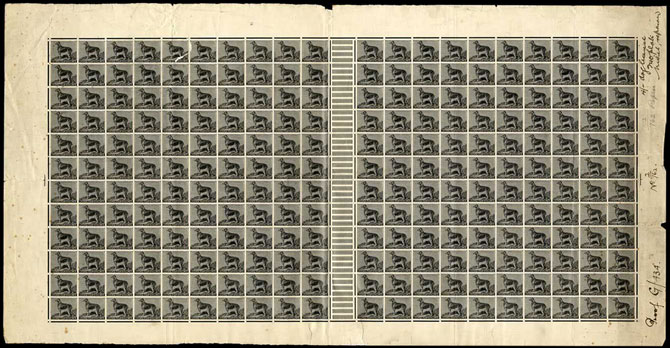
Proof of Plate 2/762.
Registration Stamps
From 1866, dog licences had to be registered in Ireland at the Petty Sessions Court for a fee of sixpence. Initially, a Petty Session stamp was used, then from 1893 an overprint “FOR DOG LICENCE” was applied. The overprinted stamp was registered on 6 Dec 1893, and announced in a Circular to Clerks of Petty Sessions on 15 Jan 1894.
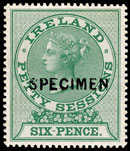
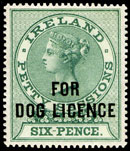
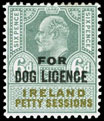
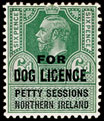
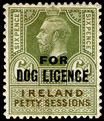
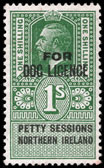
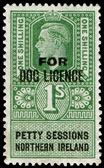
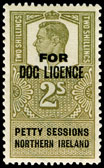
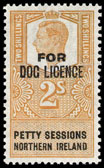
Shilling stamps in shades of green, olive, and yellow.
By Order of the Lords Justices of Northern Ireland, the registration fee was raised to 1/-, effective 1 July 1923.
By Order of the Governor of Northern Ireland, the registration fee was raised to 2/-, effective 18 Feb 1952.