The Unemployment Insurance (Agriculture) Act 1936 established a mandatory unemployment insurance scheme for agricultural workers. It provided coverage for approximately 750,000 workers, with contributions starting 4 May 1936 and benefits starting 5 Nov 1936. The scheme was extended to include approximately 125,000 private gardeners shortly after the initial act by the Unemployment Insurance (Private Gardeners Inclusion) Order 1936.
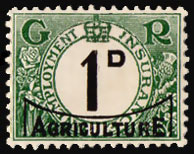
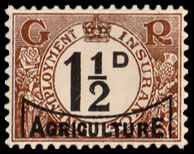
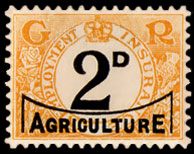
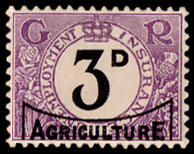
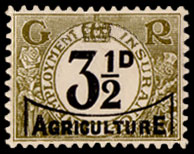
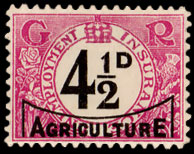
Rates were the sum of contributions paid partly by the employee and partly by the employer. The rate for an employed man, for example, was 4½d from the employee plus 4½d from the employer, for a total of 9d. Exempt workers paid only the employer part. Hence, for each rate, two stamps were required, one for an employed worker and one for an exempt worker. In this case for men, 4½d and 9d stamps were needed.
Provisional Issue
Date: 4 May 1936
Printer: HM Stationery Office
Process: Letterpress
Watermark: Block UI
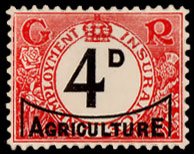
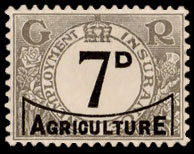
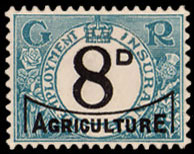
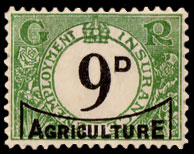
Provisional stamps were issued in ten values by overprinting the existing Unemployment Insurance design with denominations and “AGRICULTURE” in black. Colour names are known from file PIN 10/4: Myrtle Green, Dark Oak Brown, Fawn, Mauve, Sage Green, Red, Light Magenta, Grey, Turquoise Blue, and Emerald Green.
Definitive Issue
Date: 1 Apr 1938
Designer: Edmund Dulac
Printer: HM Stationery Office
Process: Letterpress
Watermark: Block UI
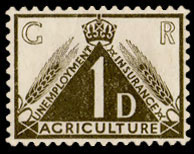
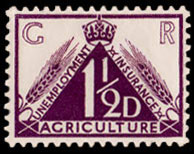
The provisional issue was in use for almost two years before being replaced by a triangle design by Edmund Dulac. There were no rate changes during this period, so the same ten values were issued, the higher values with similar colours to the provisionals. Colour names are known from file PIN 10/10: Sage Green, Mauve, Emerald Green, Dark Oak Brown, Orange, Red, Light Magenta, Grey, Turquoise Blue, and Myrtle Green.
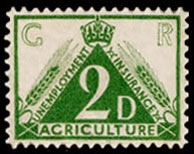
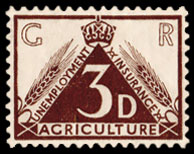
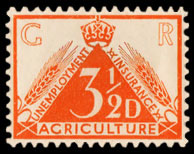
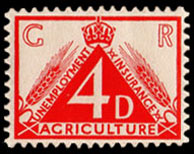
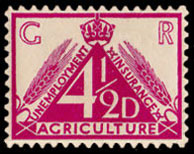
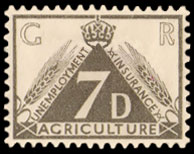
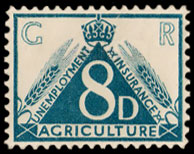
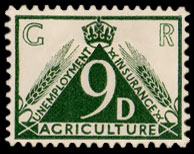
July 1938 Rate Change
On 4 July 1938, rates for adults (18 and over) were reduced by ½d due to a fund surplus (½d for the employee and ½d for the employer, for a total of 1d for employed adults). This required a new 6d stamp for the Young Woman’s rate. Additionally, the colours of the three most used stamps were to remain as Grey, Turquoise Blue, and Myrtle Green. Thus, the 6d was to be Grey, the 7d changed from Grey to Turquoise Blue, and the 8d changed from Turquoise Blue to Myrtle Green. The previous 7d Grey and 8d Turquoise Blue were withdrawn from sale at Post Offices at the close of business on Saturday, 2 July 1938.
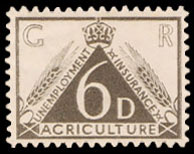
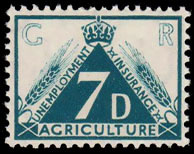
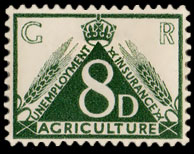
July 1939 Rate Change
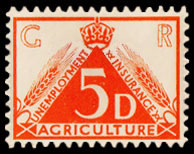
On 3 July 1939, rates for adults (18 and over) were reduced by a further 1d. This required new 2½d and 5d stamps for the Woman’s and Young Man’s rates. Colours were taken from the 4½d Light Magenta and 3½d Orange stamps which were no longer in use.
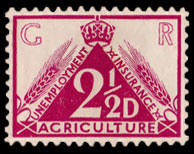
August 1940 Rate Change
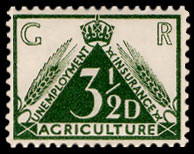
On 5 Aug 1940, rates for adults (18 and over) were increased by ½d. This required new 3½d and 7d stamps for the Man’s rates. The 3½d Orange was no longer in use and Orange had been reused for the 5d in 1939, so the 3½d was reissued in Myrtle Green. The 7d had already been changed from Grey to Turquoise Blue in 1938 and was reissued in the same colour.
July 1942 Rate Change
On 6 July 1942, rates for adults (18 and over) were increased by a further ½d, returning to 1938 levels. No new stamps were required. The following table summarises rates:
| 4 May ’36 | 4 July ’38 | 3 July ’39 | 5 Aug ’40 | 6 July ’42 | |
| Man (21–64) | 4½d | 4d | 3d | 3½d | 4d |
| Woman (21–64) | 4d | 3½d | 2½d | 3d | 3½d |
| Young Man (18-20) | 4d | 3½d | 2½d | 3d | 3½d |
| Young Woman (18-20) | 3½d | 3d | 2d | 2½d | 3d |
| Boy (16-17) | 2d | 2d | 2d | 2d | 2d |
| Girl (16-17) | 1½d | 1½d | 1½d | 1½d | 1½d |
| Boy (under 16) | 1½d | 1½d | 1½d | 1½d | 1½d |
| Girl (under 16) | 1d | 1d | 1d | 1d | 1d |
The National Insurance Act 1946, which came into effect on 5 July 1948, covered agricultural workers, so these stamps were discontinued, although remained on sale at post offices up to the end of 1948 for payment of arrears.