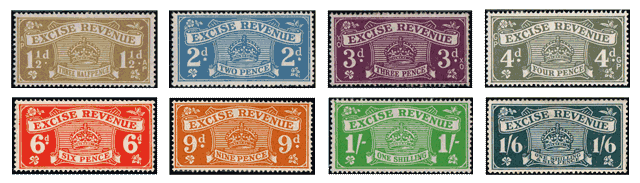
The Finance (New Duties) Act 1916, effective 15 May 1916, established a excise duty on “payments for admission to any entertainment” as a temporary war tax (it was finally repealed in 1960). The duty was paid by an adhesive stamp stuck on an entrance ticket. Stamps were usually cancelled by tearing the ticket & stamp in half, but some venues were reusing the stamp halves and so check letters were introduced in 1925.

Watermarks: Simple Cypher, Block Cypher, Block SO, Script SO
The stamps were printed by Harrison and Sons on the same Simple Cypher paper they were using for postage stamps. When the printing contract passed to Waterlow and Sons on 1 Jan 1924, the paper changed to Block Cypher and, when Waterlow’s contract expired on 31 Dec 1933, printing passed to HM Stationery Office using a Block SO paper. Circa 1950, the watermark changed to a Script SO, but no rolls were made with this paper. The duty was initially based on a scale as follows, with many modifications in the following years.
| Payment | Duty |
|---|---|
| up to 2d | ½d |
| over 2d to 6d | 1d |
| over 6d to 2/6 | 2d |
| over 2/6 to 5/- | 3d |
| over 5/- to 7/6 | 6d |
| over 7/6 to 12/6 | 1/- |
| over 12/6 | 1/- + 1/- for every further 10/- |
1916 Harrison and Sons
The four most used values of Excise Revenue stamps were issued in rolls in 1916, with a 1½d roll added in 1919 after the Finance Act 1919, effective 1 Oct 1919, introduced a 1½d duty on 4½d tickets (for a total of sixpence). The first printings were in sheets of 144 (24 rows of six). A new layout was adopted in 1921, with sheets of 120 (20 rows of six) for all values up to the one shilling. Rolls were made from strips of six stamps.
| — | 2d | 480 | £4 | Left Side | Buff | 6 |
| — | 3d | 480 | £6 | Left Side | Buff | 6 |
| — | 6d | 480 | £12 | Left Side | Buff | 6 |
| — | 1/- | 480 | £24 | Left Side | Buff | 6 |
| — | 1½d | 480 | £3 | Left Side | Buff | 6 |
The leaders below were pasted onto a sheet in Stanton’s collection. The sheet was mounted to a page with a description: Excise revenue stamps were also issued in coils. Specimen sheet of proofs. At some time since the albums were broken up, the leaders were roughly taken off the sheet, causing some thinning, and random excise revenue stamps were attached (now removed).

The format of the printer’s imprint suggests a Harrison printing up to 1920 (the company became Limited in 1920) and the 1½d issued in Oct 1919 narrows the window. Thus, these are likely 1919 to 1920, with the 4d leader 1920 to 1924. The Specimen sheet of proofs also had spaces for 6d, 9d, and 1/6 rolls, and stated that the leaders for these denominations were printed in black, with the rate and value inserted in manuscript:
1924 Waterlow and Sons
The printing contract passed from Harrison to Waterlow on 1 Jan 1924, partially on the expectation that Waterlow was to print rolls by the continuous letterpress process established at Somerset House. There were concerns expressed in November 1923 about the unprinted central gutter and it was decided to “cross perforate” the gutter with a pattern of holes to avoid any misuse. Perforation combs were made for postage, insurance, and excise revenue stamps.
The contract specified that rolls were to be sealed with printed paper bands in approximately the same colour as the stamps. Rolls of 1½d, 2d, 3d, 4d, 6d, 9d, 1/-, and 1/6 stamps could be made from sheets (joined every 6 stamps) or printed continuously. Sheet stamps (for joined rolls) were to be printed on Wharfedale printing machines. Continuous printing required a new form of printing plate with two panes of 54 (6 rows of 9) separated by a cross perforated gutter, for use on Grover’s reel printing machines. The watermark for continuous rolls could be at right angles to the vertical direction of the stamp (i.e. sideways). Plate layouts were as follows.
 144-set
 120-set
 Continuous
Click the images to enlarge.
Although the Finance Act 1917, effective 1 Oct 1917, introduced new duties of 4d, 9d, and 1/6, stamps of these values were initially only available in sheets. They were not issued in rolls until 1927, bringing the total number of rolls to eight.
| — | 4d | 480 | £8 | Left Side | Buff | 6 |
| — | 9d | 480 | £18 | Left Side | Buff | 6 |
| — | 1/6 | 480 | £36 | Left Side | Buff | 6 |
The Finance (No. 2) Act 1931, effective 9 Nov 1931, expanded the scale of duties by adding a penny duty for each extra sixpence, creating six new stamps: 2½d, 5d, 7d, 8d, 10d, and 11d. All six were available both as sheets of 120 and as rolls of 480, bringing the total number of rolls to 14.
| — | 2½d | 480 | £5 | Left Side | Buff | 6 |
| — | 5d | 480 | £10 | Left Side | Buff | 6 |
| — | 7d | 480 | £14 | Left Side | Buff | 6 |
| — | 8d | 480 | £16 | Left Side | Buff | 6 |
| — | 10d | 480 | £20 | Left Side | Buff | 6 |
| — | 11d | 480 | £22 | Left Side | Buff | 6 |
1934 HMSO
Waterlow’s contract expired on 31 Dec 1933 and printing of excise revenue stamps was transferred to HM Stationery Office. HMSO continued to use flat printing plates on Wharfedale printing machines, printing the stamps in sheets on a Block SO paper. There were no continuous printings.
Rolls of 9d, 11d, and 1/6 stamps were no longer offered from 1936 (reducing the number of rolls to 11), then 8d and 10d rolls were dropped from 1937 (reducing the number to 9). No excise revenue stamps were offered in rolls after WWII, stamps were only available as sheets. Circa 1950, the watermark changed to a Script SO, but no rolls were made with this paper. Entertainments duty was finally repealed on 9 Apr 1960.